
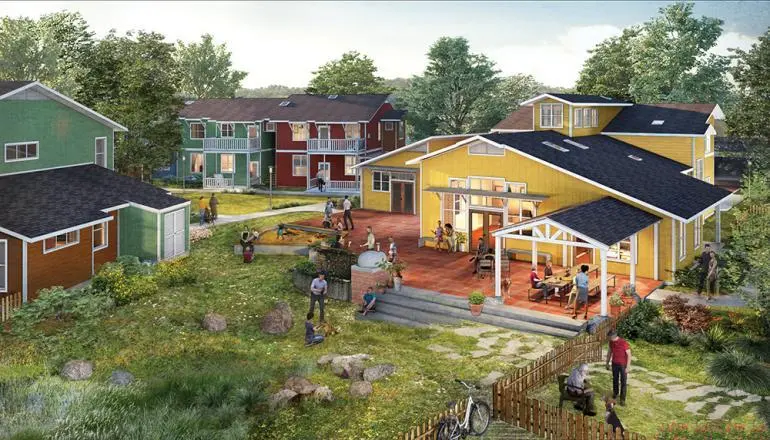
Cohousing
Experience the benefits of a safe and
supportive village-like neighbourhood
What is it?
Cohousing is an alternative approach that seeks to balance community, privacy and shared spaces to create a high functioning neighbourhood that meets peoples desire for community, while providing the privacy of a traditional home. The basic traits of cohousing include:
- An intention to create community,
- shared facilities and public space,
- a common house,
- self-governance,
- design input by future residents,
- and common meals
Who’s it good for?

Families with Younger Children
A safe place where kids can roam free with their playmates.
It’s easy to visit a neighbour-friend, yet return home to change a diaper.
Support other parents when they are having a rough moment by having their kids over for a short time.

Adults
A place where you can feel connected, safe and supported.
A base where you can have an excellent quality of life while maintaining connections intergenerataionally and with the wider community.
Support for aging in place.
Features of Cohousing
Participatory Process
Put your stamp on it! Your values will be reflected in the development of the community, so that it directly responds to your needs.
Neighborhood Design
You’ll feel the difference. The physical design of the neighbourhood encourages a sense of community as well as maintaining privacy. Usually, there is a pedestrian-oriented design with the cars at the periphery, so you meet neighbours throughout the day, and the kids have a safe place to play.
Private Homes Supplemented by Common Facilities
In addition to your own private apartment, you will share common spaces and facilities. They typically include a group dining and sitting area, children’s play room, guest suites, as well as garden and other amenities. Each household occupies a private residence complete with kitchen, but also shares extensive common facilities with the larger group.
Resident Management
You and your neighbours will take care of the community spaces, and look out for each other, after move-in. The community is not dependent on any one person, even though there are often a few “burning souls” that get the community off the ground, and others that pull together the financing, and ensure that you, the group, has childcare for meetings, etc.
Sociocracy and Compassionate Communication
Kingston Cohousing uses sociocracy as a governance structure. Sociocracy ensures that everyone is heard, and decisions are made on the basis of “good enough to try”. This approach reduces some of the challenges of consensus decision-making.
When we pay attention to the words we use and the way we use them, we improve the odds of strengthening and deepening our most meaningful relationships. Compassionate Communication (or Non Violent Communication / NVC ) offers a technique for communicating compassionately which relies on four core steps:
- Observing a situation without judgment;
- Discerning which emotions are being triggered in the situation;
- Connecting those emotions to the underlying needs that aren’t being addressed; and
- Making a reasonable request of the other person.
FAQs
About Cohousing
What is Cohousing?
From the Canadian Cohousing Network:
- “Cohousing provides personal privacy combined with the benefits of living in a community where people know and interact with their neighbours. It’s about living in a way that’s responsive to a world that has changed dramatically in the last fifty years… Cohousing offers hope in our often dissociated society. Through cohousing, we can build a better place to live, a place where we know our neighbours, a place where we can enjoy a rich sense of community and contribute to a more sustainable world.”
From the Cohousing Association of the United States:
- “Cohousing is community designed to foster connection. Physical spaces allow neighbors to easily interact with others just outside private homes. Common areas including kitchen, dining space and gardens bring people together. Collaborative decision-making builds relationships.
Prefer to learn from a book? Our local public libraries can help you out:
The Senior Cohousing Handbook: A Community Approach to Independent Living, by Charles Durrett (North Vancouver City Library) (Vancouver Public Library)
Creating Cohousing: Building Sustainable Communities, by Kathryn McCamant and Charles Durrett (North Vancouver City Library) (Vancouver Public Library)
The Cohousing Handbook: Building a Place for Community, by Chris ScottHanson and Kelly ScottHanson (North Vancouver City Library) (Vancouver Public Library)
Community Building
Cohousing community values are based on working cooperatively. We will work together to create this community, both in terms of the building under construction, and the social connections amongst neighbours.
Participation
Our community will succeed and thrive based on member participation. Each person finds their own niche, based on their skills, passions and capacity to contribute. In addition, we recognize that flexibility is important (e.g. new baby, family illness, disability).
Typical areas in which people choose to participate are governance (e.g. committees, facilitation, record keeping, bookkeeping), physical work (e.g. gardening, maintenance) and community building (e.g. social events, conflict resolution).
The community will also have a system of common meals, typically 2 to 3 times per week and are optional to attend (if it works for your schedule and sounds tasty!). In each 4 week cycle, everyone signs up for cooking and/or cleaning shifts, according to their skills and interests. Each meal is cooked by a team and gratefully enjoyed by a group of neighbours, and then cleaned up by another team.
Consent based decision-making
Cohousing typically uses consensus decision-making, which is a cooperative process in which the community works together to understand an issue and develop a suitable proposal, and agrees to support a decision that is in the best interest of the whole group (as opposed to a decision that is in the best interest of certain individuals). In cohousing jargon, it usually works out as “most people get most of what they want, most of the time”.
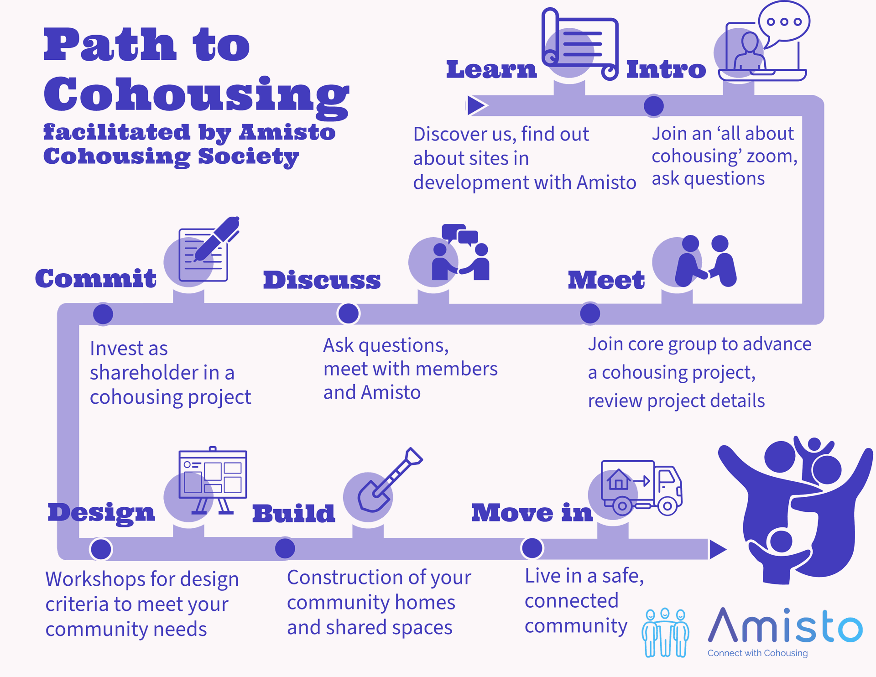
Path to cohousing
Intergenerational
Intergenerational housing improves health outcomes for everyone, building an overall sense of trust and increasing social connections.
CHILDREN and YOUTH
Children benefit from living in an intergenerational cohousing community. There are always other kids to play with (and to practice working out differences) and neighbours are available to supervise a park mission, read a book or teach a craft. Children demonstrate more interactive and cooperative play while youth show an improved sense of self-worth and empathetic communication.
ADULTS
Especially for parents of young children, cohousing can smooth some of the wrinkles of day-to-day life and reduce parent burn-out by sharing common activities. Besides the convenient camaraderie of our common meal system, knowing your neighbours comes in handy when school has early dismissal or you’re hoping to swap childcare.
SENIORS
Seniors can be vulnerable to isolation. Aging in place in a community where you’re known, needed and participating can alleviate that risk and lead to more joyful ageing.